

As artificial intelligence becomes our preferred source of information, could it eventually undermine the very ecosystem it depends upon?
By Daniel Borg | psyborg®
We are entering an extraordinary period in human history.
Artificial intelligence can research, explain, summarise and generate information in seconds. What once required hours of reading, investigating and comparing sources can now be accomplished through a single conversation.
It’s remarkable technology. But I’ve been thinking about a potential consequence.
What happens when we stop visiting the original sources of information because AI has already given us the answer?
And more importantly, what happens to AI when those original sources begin to disappear?
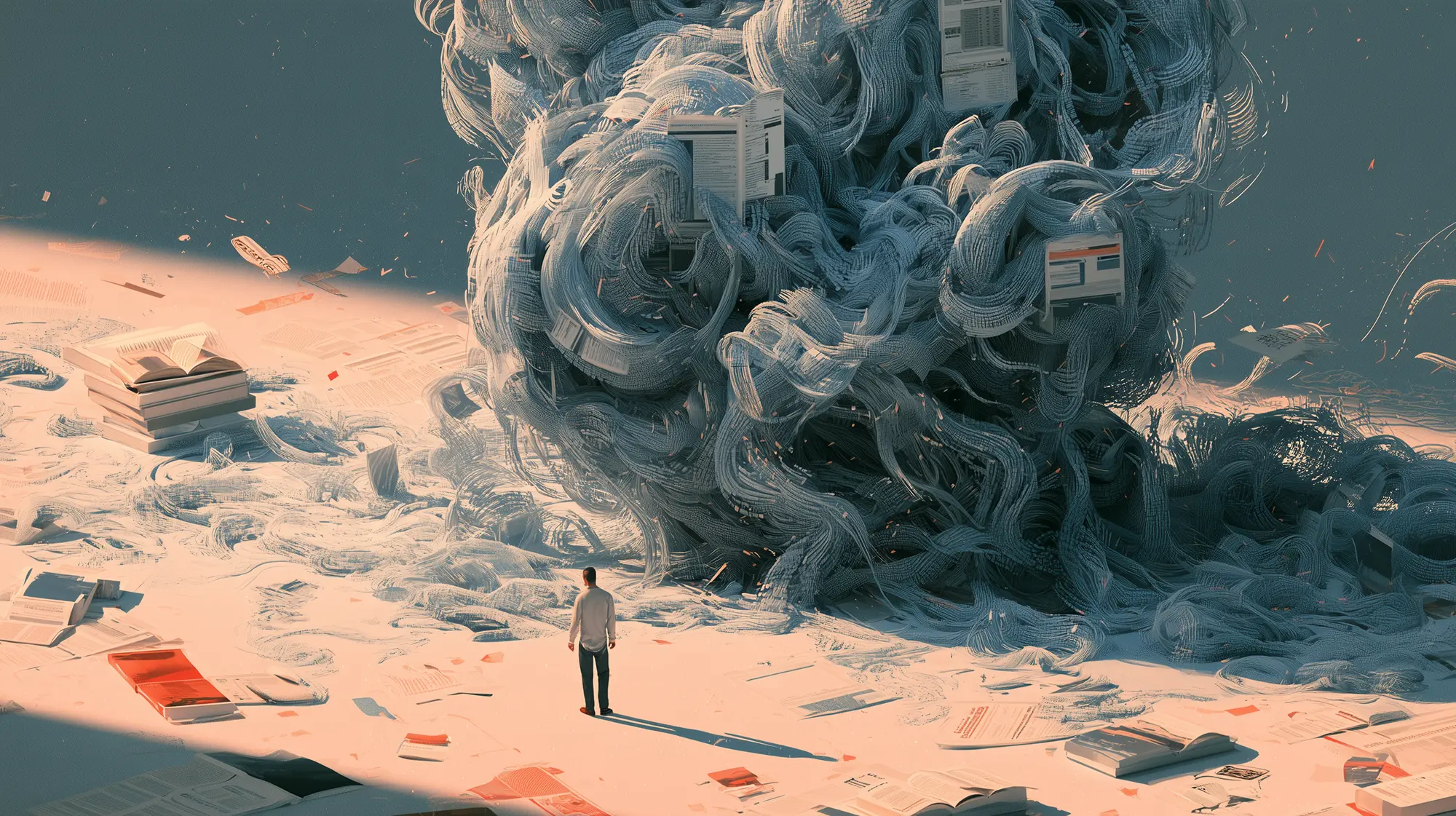
I call this concept The AI Blob.
The Disappearing Incentive to Create
Consider how the internet has traditionally worked.
Researchers, journalists, educators, businesses and independent creators produce original information. Search engines help people discover it. Those people visit websites, read articles, engage with content and potentially generate revenue for its creators.
That relationship creates an incentive to continue producing information.
AI changes this exchange.
Instead of visiting five websites to understand a subject, we can ask AI to synthesise the information into one convenient answer.
The original creators might never receive a visit.
According to Pew Research Center, a 2025 study found users clicked traditional search results in 8% of visits when an AI summary appeared, compared with 15% without one. The study shows an association, not proof that AI alone caused the difference.
The implication is significant.
If creators lose the audience, recognition or financial return that supports their work, some will inevitably question whether the effort remains worthwhile.
And if fewer people produce original information, where does the next generation of AI obtain its knowledge?
When AI Starts Feeding on AI
Imagine an information ecosystem where increasingly large volumes of content are generated by artificial intelligence.
AI creates articles. Other AI systems summarise those articles. New content is generated from those summaries. Eventually, future AI models may train on information produced by earlier models.
Information continues multiplying.
But is knowledge actually increasing?
Researchers have already identified a related phenomenon known as model collapse.
A 2024 study published in Nature demonstrated that repeatedly training generative models on recursively generated data can lead to degraded outputs, including the loss of less common information and patterns.
Importantly, subsequent research has shown this outcome can be mitigated by retaining genuine data and managing synthetic training data appropriately.
So model collapse isn’t inevitable.
Nevertheless, it exposes a vulnerability in an information system increasingly dependent on its own output.
AI could become exceptionally good at reproducing information while becoming progressively disconnected from original discovery.
The Creative Consequence
This issue extends beyond factual knowledge.
It also raises questions about creativity.
Imagine thousands of designers, writers and marketers asking similar AI systems to generate ideas about similar subjects.
The results might be polished, professional and technically impressive.
But what happens to originality?
A 2024 study published in Science Advances found that AI assistance improved the perceived creativity of individual short stories while making the resulting stories more similar to one another.
Individual output improved. Collective diversity declined.
That’s an intriguing contradiction.
We could end up creating more content than ever before while producing fewer genuinely different ideas.
More volume. Less variation.
More information. Less exploration.
A growing blob of content that increasingly resembles itself.
Could AI Eventually Become Stale?
I don’t believe AI will simply stop learning.
The physical world continues changing. Scientists conduct experiments. Businesses innovate. People experience things that have never happened before.
AI can also contribute to genuinely new discoveries through experimentation, scientific modelling and analysis.
Knowledge will continue to develop.
But there’s an important distinction between knowledge being created and knowledge being widely accessible.
If original research becomes less commercially viable, increasingly restricted or simply harder to distinguish from synthetic content, AI could struggle to access the diversity of reliable information required to remain useful.
Rather than becoming completely static, our mainstream information environment could become increasingly repetitive.
New discoveries might still occur, but our everyday answers could be dominated by recycled interpretations of existing knowledge.
The AI Blob isn’t necessarily a shortage of information. It’s a shortage of originality within an abundance of information.
Why Human Thinking Could Become More Valuable
This brings me to something I’ve always believed about the relationship between creativity and technology.
Technology should amplify human thinking, not replace the need for it.
At psyborg®, our philosophy is part mind | part machine.
AI is an extraordinary tool for research, productivity, exploration and production.
But its greatest potential emerges when we combine those capabilities with human observation, original ideas, practical experience and independent judgement.
In a world where almost anyone can generate professional content, the ability to bring something genuinely new to the conversation becomes increasingly valuable.
The advantage won’t necessarily belong to those who generate the most content.
It may belong to those who contribute the most original thinking.
That also means we need to rethink how creators are recognised and rewarded. Attribution, licensing, sustainable publishing and support for original research aren’t peripheral issues. They’re central to the long-term health of the AI ecosystem.
Avoiding The AI Blob
The challenge isn’t to stop using artificial intelligence.
It’s to prevent AI from becoming a closed loop of endlessly recycled information.
We need to continue researching, investigating, experimenting, creating and questioning.
We need technology that recognises the value of original sources rather than simply extracting information from them.
And we need humans who remain curious enough to look beyond the first convenient answer.
Because the greatest risk might not be that artificial intelligence stops learning.
It might be that humans gradually stop contributing the original knowledge that makes AI intelligent in the first place.
The future needs more than artificial intelligence. It needs original intelligence.
part mind | part machine.
Research references

Daniel Borg
Creative Director
psyborg® was founded by Daniel Borg, an Honours Graduate in Design from the University of Newcastle, NSW, Australia. Daniel also has an Associate Diploma in Industrial Engineering and has experience from within the Engineering & Advertising Industries.
Daniel has completed over 2800 design projects consisting of branding, content marketing, digital marketing, illustration, web design, and printed projects since psyborg® was first founded. psyborg® is located in Lake Macquarie, Newcastle but services business Nation wide.
I really do enjoy getting feedback so please let me know your thoughts on this or any of my articles in the comments field or on social media below.