

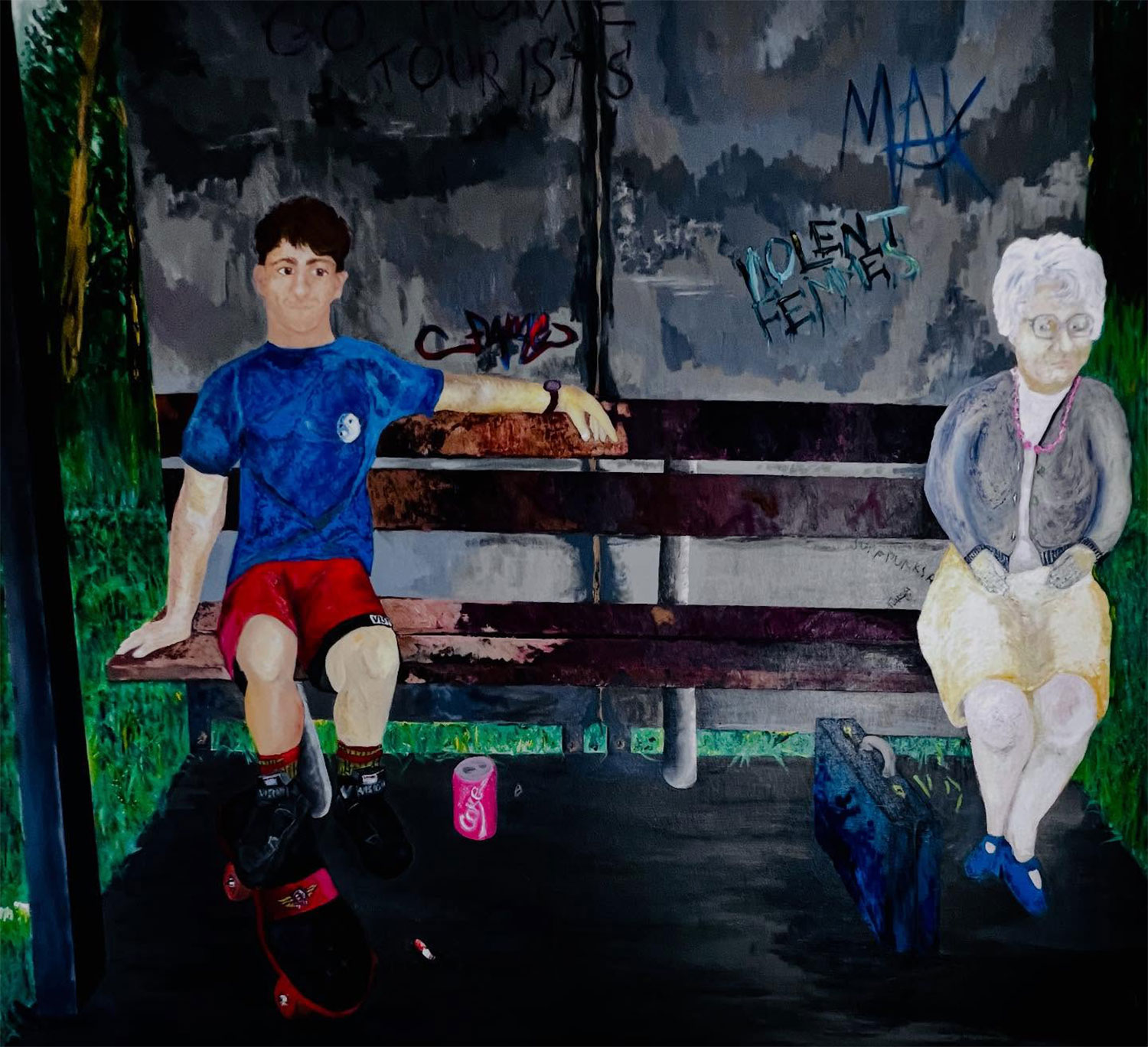
In 1992, I painted my Year 12 Major Art Work.
It was titled The Generation Gap.
At the time, the idea lived entirely inside the image.
A 17-year-old version of me waits for a bus. Relaxed. Open. Skateboard at my feet.
Beside me, an elderly woman perches on the edge of the seat, her baggage held close, acting as a barrier.
Same bench. Same moment. Different worlds.
It was a painting about proximity without connection.
About how generations can share space, yet experience time very differently.
The Human Artwork … Lived Symbolism
The original painting is anchored in lived experience.
Every element carries intention:
- The skateboard represents freedom, movement, and youth culture. It rests casually. I could leave at any moment.
- The Coca-Cola can and cigarette speak to a carefree, disposable attitude. Youthful presence rather than permanence.
- The elderly woman’s baggage is weight … physical, emotional, and historical. It creates a boundary.
- Graffiti is voice. Teenage identity. Territory. Rebellion. A moment in cultural time.
The bench becomes more than furniture.
It becomes a metaphor for time itself.
Everyone is waiting.
But not everyone waits the same way.
In 1992, painting was the highest-resolution way to translate that experience.
Time, skill, and intent were visible in every brushstroke.

Re-Rendering the Same Idea with AI
Recently, I asked AI to re-render the painting as a real-life photograph.
Same composition.
Same proportions.
Same objects.
Different medium.
What surprised me wasn’t that it worked …
It was how credible it felt.
The AI version isn’t lesser.
It isn’t an imitation.
It’s native to now.
Where the Generation Gap Shifts
Originally, the generation gap lived inside the artwork.
Youth versus age.
Openness versus withdrawal.
Freedom versus accumulation.
With the AI version, the gap moves outside the frame.
The new tension is not between people.
It’s between mediums.
| 1992 | Now |
| Hand-painted interpretation | Machine-generated realism |
| Artist as maker | Artist as director |
| Meaning inside the image | Meaning between versions |
| Time invested in execution | Time invested in intention |
The idea survives.
The method evolves.
That’s not replacement.
That’s translation.
Art, Memory, and Machines
AI doesn’t remember the past.
It reconstructs it.
And that matters.
The AI image isn’t about nostalgia.
It’s about how meaning is now assembled from collective visual memory.
In this context, realism becomes the new baseline.
Credibility comes from simulation, not brushwork.
The artwork hasn’t lost its soul.
The soul has simply moved upstream … into concept, context, and direction.
Where Artwork Is Evolving
We’re entering a phase where:
- Execution is accelerated.
- Tools are democratised.
- Meaning carries more weight than method.
The role of the artist shifts from:
“Can I make this?”
to:
“Should this exist, and why?”
Ideas that are strong enough don’t disappear.
They adapt.
The Generation Gap no longer describes just age.
It now describes how creativity itself moves through time.
From hand
to machine
to something new.
Closing Thought
The original painting captured a moment in 1992.
The AI version captures how that moment survives today.
Same story.
Different era.
Different tools.
And that, in itself, is the new artwork.
Design with intent.
Creativity, fuelled by logic.
Part mind. Part machine.
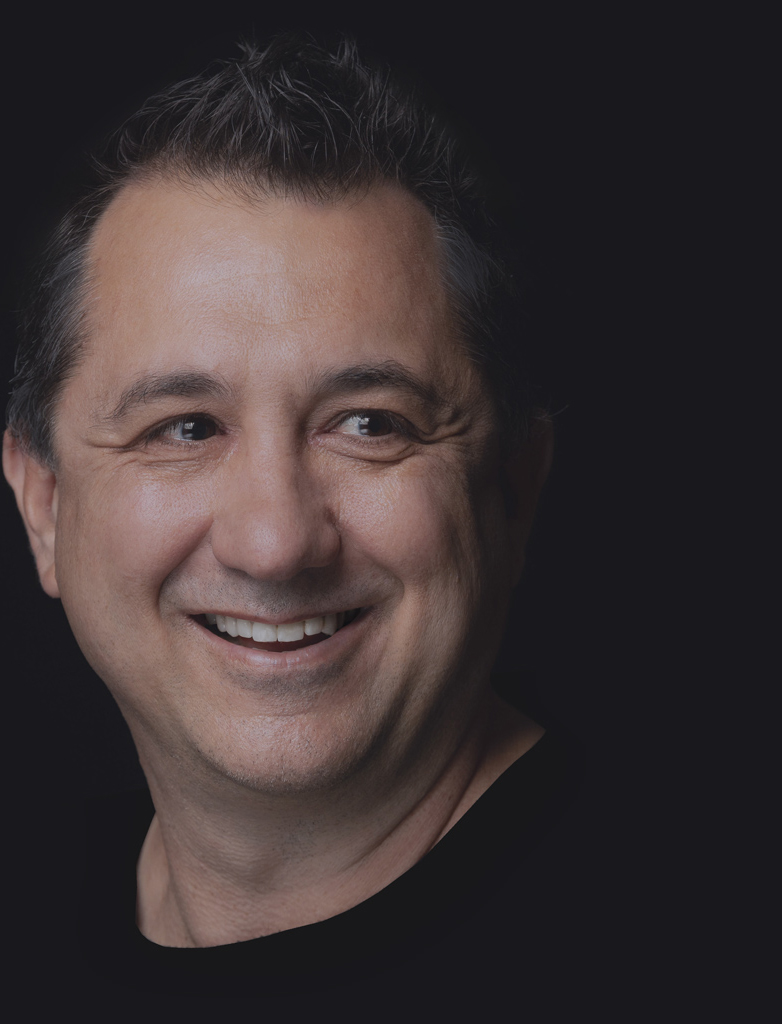
Daniel Borg
Creative Director
psyborg® was founded by Daniel Borg, an Honours Graduate in Design from the University of Newcastle, NSW, Australia. Daniel also has an Associate Diploma in Industrial Engineering and has experience from within the Engineering & Advertising Industries.
Daniel has completed over 2800 design projects consisting of branding, content marketing, digital marketing, illustration, web design, and printed projects since psyborg® was first founded. psyborg® is located in Lake Macquarie, Newcastle but services business Nation wide.
I really do enjoy getting feedback so please let me know your thoughts on this or any of my articles in the comments field or on social media below.