

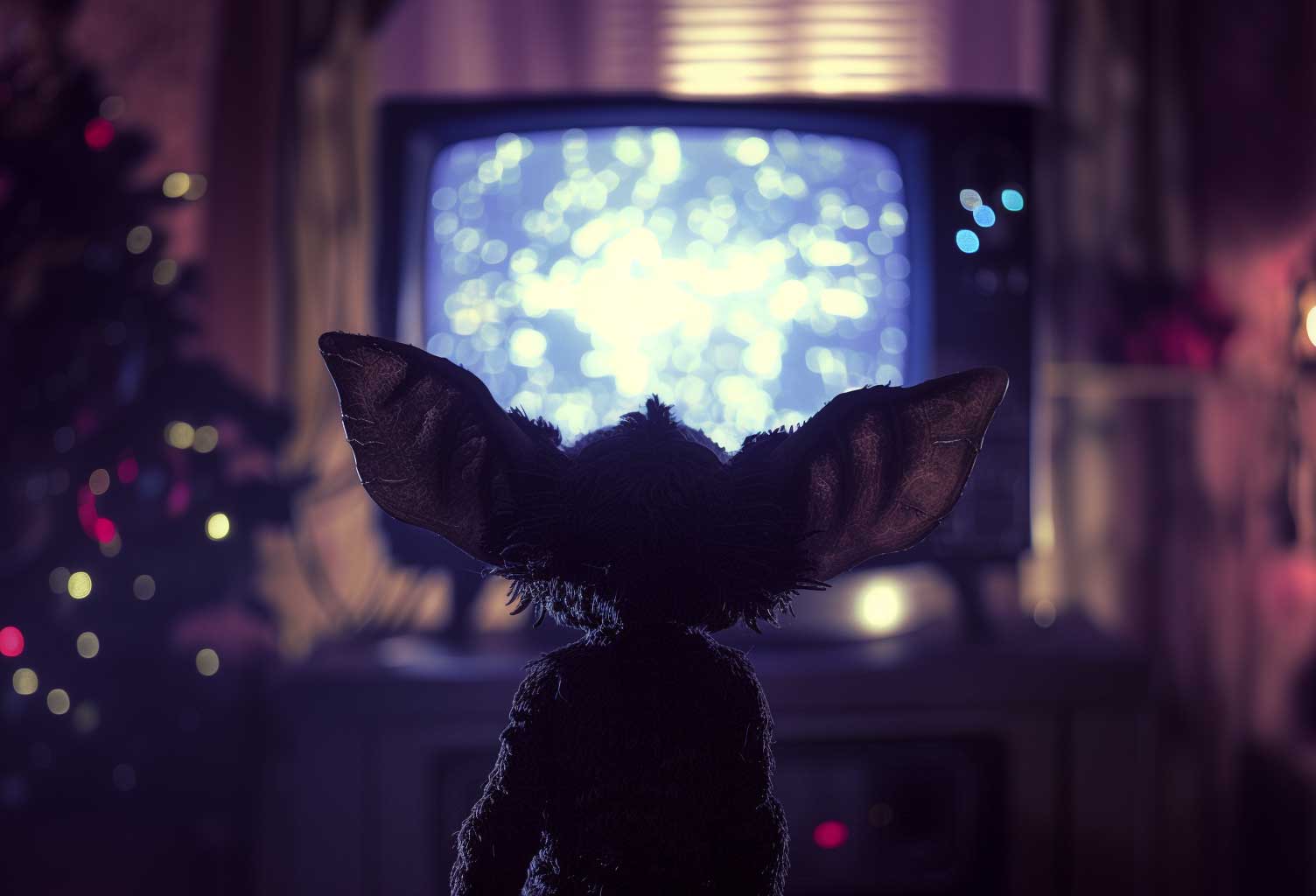
The other night I re-watched Gremlins with my son.
At face value it’s chaos. Christmas lights. Mischievous creatures. Exploding kitchens. Cartoon mayhem. Fun and slightly unhinged.
But this time something clicked.
I wasn’t just watching a movie. I was watching a designed system.
And once you see it, you can’t unsee it.
What looks like random humour is actually a carefully layered conversation between Steven Spielberg, director Joe Dante, animation history, suburbia and culture itself. More interestingly… the same principles explain why some brands feel iconic while others disappear.
Design with intent.
The Spielberg Connections You Start to Notice
Watching closely, Gremlins is filled with echoes of Spielberg’s wider cinematic language.
Not nostalgia … structure.
Small moments begin to stand out:
- Gizmo tapping the keyboard mirrors musical communication in Close Encounters of the Third Kind.
- A gremlin disguising itself among toys recalls E.T. hiding in the closet.
- An E.T. plush toy appears in Billy’s bedroom.
- Backlit kitchens glow with the same mysterious lighting Spielberg used to turn suburbia into something magical.
- Mechanical toys and gadgets echo Spielberg’s recurring fascination with technology and wonder.
- Even the mysterious Chinatown shop feels like an Indiana Jones artefact opening… an object with rules attached.
These aren’t accidents. They create familiarity through repetition. Spielberg helped establish a visual grammar where ordinary suburbia becomes extraordinary the moment an unknown object enters the system.
Then the Cartoon Layer Appears
The real shift happens when you notice something else.
The gremlins don’t behave like horror monsters.
They behave like Looney Tunes characters.
They laugh while destroying things. They perform. They weaponise props like cartoon villains. Chaos becomes choreography rather than fear.
Then comes the key scene… gremlins sitting peacefully in a cinema watching Disney’s Snow White and the Seven Dwarfs, singing together.
That moment quietly explains the entire film.
Disney represents ordered fantasy… innocence, harmony and moral clarity.
Warner Bros cartoons represent anarchic fantasy… rule-breaking, exaggeration and chaos.
Gremlins is what happens when cartoon logic invades a Disney world.
Joe Dante, heavily influenced by classic Warner Bros animation, intentionally blended slapstick cartoon energy with live-action suburbia to create satire rather than pure horror.
Suburbia as a Designed System
Across Spielberg-era films, suburbia isn’t just a setting. It’s a controlled environment.
Safe homes. Predictable routines. Familiar technology.
Then something enters the system.
-
E.T. → wonder heals suburbia.
-
Poltergeist → technology terrifies it.
-
Gremlins → consumer chaos disrupts it.
-
Back to the Future → innovation restores balance.
Each story tests the same underlying idea:
Can ordinary people control the systems they live inside?
The Mogwai isn’t just a creature. It’s a product with instructions:
Don’t expose it to light.
Don’t get it wet.
Don’t feed it after midnight.
Ignore the rules… chaos multiplies.
The film becomes less about monsters and more about responsibility inside complex systems… a theme widely recognised in analysis of 1980s Amblin films reflecting technological and cultural change.
Meaning Wasn’t Fully Planned… It Emerged
Spielberg and Dante didn’t sit down designing an academic metaphor.
But they were working inside the same cultural moment:
-
rapid technological change,
-
rising consumer culture,
-
expanding suburbia,
-
media saturation.
Artists absorb their era intuitively. When enough intentional creative choices align, deeper meaning emerges naturally over time.
The film becomes coherent beyond intention.
Exactly how strong brands evolve.
What This Has to Do With Branding
Rewatching Gremlins, the connection to brand building becomes obvious.
Great films and great brands follow the same principles.
They don’t create assets.
They create worlds.
1. Worlds, Not Deliverables
Spielberg didn’t design scenes. He designed emotional rules.
Strong brands do the same.
Instead of isolated outputs… logo, website, campaign… everything operates under shared laws:
-
tone
-
behaviour
-
visual language
-
emotional promise
Consistency creates trust.
2. Recurring Motifs Create Memory
You recognised Spielberg references because they repeat.
Iconic brands repeat signals deliberately:
-
Apple’s light and material simplicity
-
Nike’s motion and momentum
-
IBM’s structured visual rhythm
Recognition happens before cognition.
People feel familiarity before they analyse it.
3. Meaning Lives in Contrast
Gremlins works because of tension:
Cute vs Destructive
Innocent vs Chaotic
Domestic vs Uncontrollable
Memorable brands also hold controlled contradiction:
Premium yet Human
Creative yet Logical
Technical yet Approachable
Contrast creates identity.
Part mind. Part machine.
4. Behavioural Rules Matter More Than Style
Gremlins follow cartoon physics consistently.
Strong brands also follow behavioural logic.
If a brand were a character:
-
how does it speak under pressure?
-
how does it apologise?
-
how does it explain complexity?
Consistency of behaviour builds authenticity faster than visuals alone.
Modern Brand Designers Thinking the Same Way
This cinematic thinking didn’t stay in film. Many contemporary brand designers build identities using the same system logic.
Michael Bierut — Mastercard
Rather than reinventing the brand, Bierut refined it into a system that works seamlessly across digital & physical environments through repetition and clarity.
Jony Ive — Apple
Working alongside Steve Jobs, Ive helped create one of the clearest brand worlds ever built… where product, packaging, retail and interface all follow the same emotional logic.
Collins — Spotify, Dropbox, Mailchimp
Collins designs adaptive brand systems that evolve while remaining recognisable, proving modern brands must behave consistently across changing platforms.
Jessica Walsh — &Walsh
Walsh blends emotional storytelling and structured identity systems, showing brands today must operate culturally, visually and behaviourally at once.
These designers aren’t creating logos.
They’re designing meaning systems.
Where psyborg® Fits
Watching Gremlins again made something clear.
The same pattern exists inside psyborg®’s evolution.
Rather than operating as a traditional design studio, psyborg® increasingly works as a brand systems partner, blending strategy, design and AI to help organisations navigate complexity and change.
The goal isn’t just to launch brands.
It’s to build frameworks that allow brands to evolve coherently over time.
In an era where technology accelerates production, coherence becomes the real differentiator.
Technology makes content faster.
Systems make brands recognisable.
Creativity, fuelled by logic.
The Spielberg Test
After noticing these patterns, a simple idea emerged.
You can evaluate a brand the same way Spielberg built emotional cinema.
Before designing anything, ask:
|
Spielberg Test |
Brand Question |
|---|---|
|
Recognisable world |
Does the brand feel coherent beyond the logo? |
|
Recurring motifs |
Are there repeatable visual or narrative signals? |
|
Emotional role |
Does the brand create a clear feeling? |
|
Internal rules |
Would different designers reach similar decisions? |
|
Symbolic anchor |
Is there one memorable element people recall first? |
If the answers are unclear, the brand isn’t a system yet.
It’s decoration.
Final Thought
Rewatching Gremlins reminded me that iconic work rarely announces its intelligence.
It simply feels intentional.
Films, like brands, succeed when every detail quietly obeys the same invisible logic. Over time audiences don’t just recognise them… they trust them.
Because coherence signals authorship.
Design with intent.
Part mind. Part machine.
psyborg® is a Newcastle-based brand identity and graphic design studio. We help businesses build brands with intent … blending creativity with logic to create identities that connect and endure. Contact us to discuss your brand today.

Daniel Borg
Creative Director
psyborg® was founded by Daniel Borg, an Honours Graduate in Design from the University of Newcastle, NSW, Australia. Daniel also has an Associate Diploma in Industrial Engineering and has experience from within the Engineering & Advertising Industries.
Daniel has completed over 2800 design projects consisting of branding, content marketing, digital marketing, illustration, web design, and printed projects since psyborg® was first founded. psyborg® is located in Lake Macquarie, Newcastle but services business Nation wide.
I really do enjoy getting feedback so please let me know your thoughts on this or any of my articles in the comments field or on social media below.