

When people think of logos they think about customers.
Recognition.
Marketing.
Trust.
Sales.
That’s what logos are supposed to do… communicate meaning to other people.
But I think there is another type of logo.
One that almost nobody talks about.
One that isn’t designed to influence others.
It’s designed to influence you.
I call it The Anti Logo™.
Brands Are a Language
In a previous article I argued that branding is a form of language.
A logo is not simply a graphic.
It’s a symbol that becomes shorthand for a much larger idea.
The Christian Cross isn’t just two intersecting lines. It represents sacrifice, hope and redemption for billions of people.
The Nike Swoosh isn’t just a curved line. It represents movement, athleticism and aspiration.
The Apple logo isn’t simply a piece of fruit. It evokes simplicity, creativity and beautifully crafted technology.
Each symbol compresses an enormous amount of meaning into something your brain can recognise in milliseconds.
That’s what effective branding does.
It creates symbolic language.
The more consistently that symbol is reinforced across culture the stronger its meaning becomes.
What If You Turned Branding Inwards?
Traditional branding follows a simple pattern.
Values → Logo → Audience
The logo communicates a company’s values to the outside world.
But what if we reversed the direction?
Logo → Values → Behaviour
Instead of communicating to customers…
…the symbol communicates back to its creator.
The logo becomes a psychological cue.
A reminder.
A challenge.
A compass.
Its purpose isn’t recognition.
Its purpose is transformation.

My Own Anti Logo™
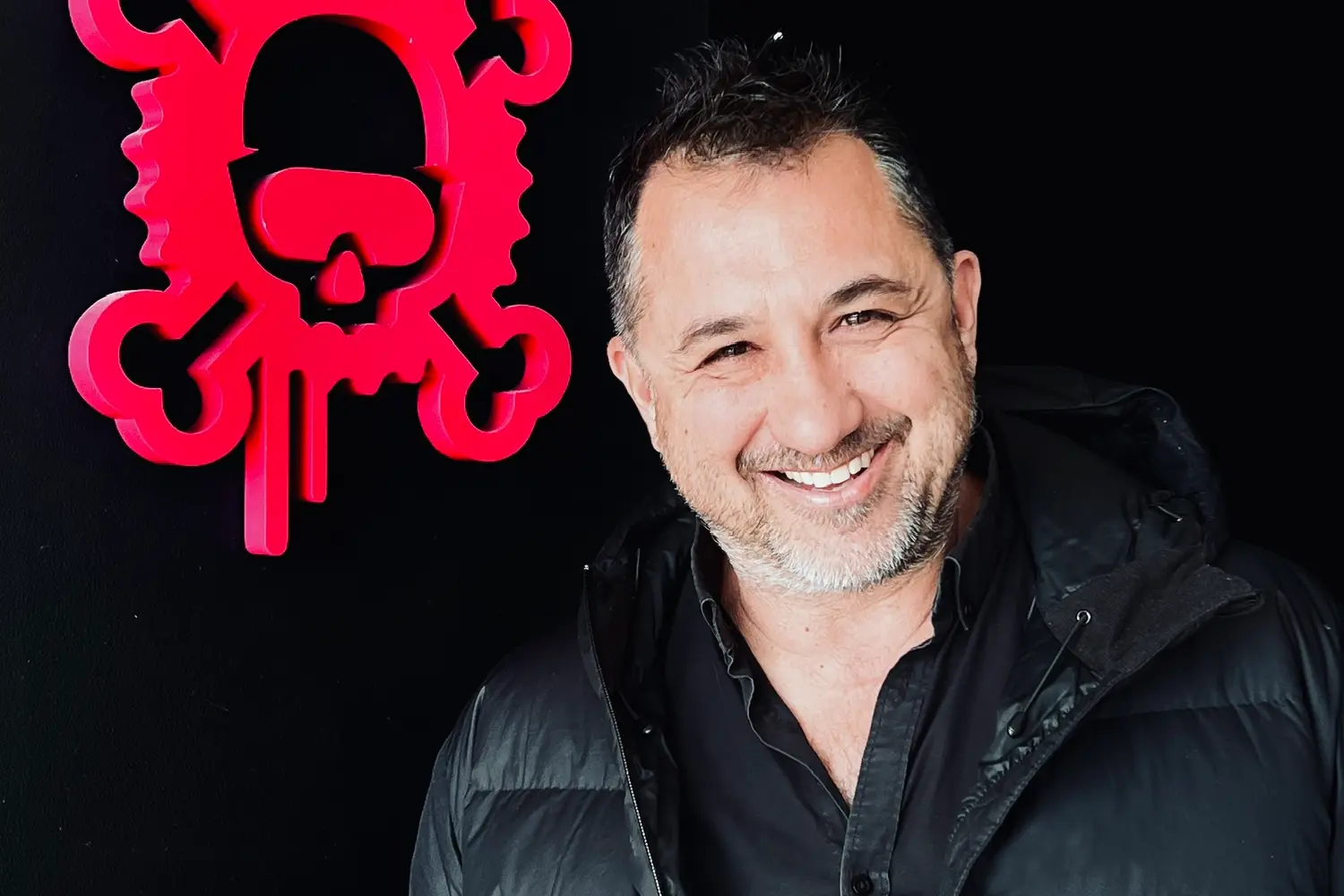
Twenty years ago when I started psyborg® I designed a symbol that very few people truly understood.
At first glance it looks like an edgy skull.
Almost pirate-like.
Many people simply think it looks cool.
But that was never its primary purpose.
It was built for me.
Every time I look at it I remember one simple truth.
One day I will die!
That might sound dark.
For me it has always been incredibly freeing.
It reminds me not to waste time.
To take calculated risks.
To keep learning.
To evolve.
To experiment.
To create.
To stay agile.
I don’t want to reach the end of life wondering what could have been.
The logo quietly reminds me every day.
Every Element Has Meaning
Like any well-designed brand every element contributes to a larger narrative.
| Symbol | Meaning |
| Skull | Mortality. Urgency. The finite nature of life. |
| Crossbones | Risk. Adventure. Breaking convention. |
| Mechanical goggles | Seeing differently through technology. Enhanced vision. |
| Gear | Engineering. Systems thinking. Machines. Precision. |
| Paint drips | Creativity. Experimentation. Play. Imperfection. |
| Crest or badge form | Identity. Personal code. Something to live by. |
Individually they’re interesting.
Together they become something much larger.
A personal operating system.
An Anti Logo™ Isn’t About Marketing
Nobody needs to understand it.
That’s the point.
It exists to reinforce your own identity.
Behavioural science has repeatedly shown that our environment shapes our decisions.
Objects surrounding us become cues that reinforce habits, routines and identity. James Clear describes this as identity-based behaviour… lasting habits emerge from reinforcing who we believe we are rather than focusing solely on outcomes. – Atomic Habits.
An Anti Logo™ works in exactly the same way.
Each encounter becomes a tiny psychological nudge.
Not consciously.
Subconsciously.
Over years those nudges compound.
Designing a Symbol for Your Future Self
Traditional branding asks questions like:
What do we want customers to think?
What emotions should this brand evoke?
How do we differentiate ourselves?
An Anti Logo™ asks something entirely different.
Who do I need to become?
What values must I never forget?
What behaviours should this symbol continually reinforce?
What reminders do I need every single day?
The answers won’t always be comfortable.
They probably shouldn’t be.
More Than a Logo
Perhaps the greatest irony is that your most meaningful logo may never become public.
It might live on:
- your notebook
- your desktop wallpaper
- your office wall
- your journal
- your workshop
- your studio
Its job isn’t to impress anyone.
Its job is to quietly shape the person looking back at it every day.
The Future of Branding?
I don’t think branding only exists to influence culture.
I think it can influence the creator as well.
External brands change how the world sees you.
An Anti Logo™ changes how you see yourself.
Perhaps that’s where the strongest brands begin.
Not in the marketplace.
But in the mind.
References
| Reference | Contribution |
| Atomic Habits | Identity-based habits and environmental cues. |
| The Presentation of Self in Everyday Life | Identity as something continually performed and reinforced through symbols and interaction. |
| Mindstorms | The idea that external artefacts can shape thinking and cognition. |
| The Hidden Dimension | Environmental psychology and the influence of physical surroundings on behaviour. |
| The Forest of Symbols | How symbols carry layered cultural and personal meaning. |
Daniel Borg
Creative Director
psyborg® was founded by Daniel Borg, an Honours Graduate in Design from the University of Newcastle, NSW, Australia. Daniel also has an Associate Diploma in Industrial Engineering and has experience from within the Engineering & Advertising Industries.
Daniel has completed over 2800 design projects consisting of branding, content marketing, digital marketing, illustration, web design, and printed projects since psyborg® was first founded. psyborg® is located in Lake Macquarie, Newcastle but services business Nation wide.
I really do enjoy getting feedback so please let me know your thoughts on this or any of my articles in the comments field or on social media below.