

Every new logo adds a word to our visual vocabulary.
Language didn’t appear overnight.
Someone, somewhere, decided that a collection of sounds would represent an object. Over time those sounds became words. Words became sentences. Sentences became stories. Stories shaped culture.
Branding follows a remarkably similar path.
Every time a designer creates a new logo, they aren’t simply producing a graphic. They’re creating a new visual symbol that will eventually represent an idea.
Initially that symbol means nothing.
After thousands of interactions it can mean everything.
At psyborg® we’ve started to think of branding differently.
We don’t believe we’re simply designing logos.
We’re helping create new language.
From Letters to Logos
The alphabet is an elegant system.
Twenty-six letters combine into millions of words capable of expressing almost every human thought.
Each letter is meaningless on its own.
Meaning only emerges through shared understanding.
Branding works in much the same way.
| Language | Branding |
| Letters represent sounds | Logo marks represent ideas |
| Words create meaning | Brand systems create narratives |
| Grammar provides consistency | Brand guidelines provide consistency |
| Conversation spreads language | Customer experiences spread brands |
| Language shapes culture | Brands influence culture |
A new logo begins life as an abstract arrangement of shapes.
Nothing more.
Then people begin attaching experiences to it.
A great product.
Helpful staff.
Excellent service.
Shared values.
Consistency.
Trust.
Eventually the symbol stops being recognised for what it looks like and starts being recognised for what it means.
That’s when a logo becomes language.
The Science Already Exists
This idea isn’t entirely new.
The study of semiotics examines how signs and symbols create meaning within society.
Swiss linguist Ferdinand de Saussure argued that signs have no inherent meaning. Their meaning exists because people collectively agree upon it.
American philosopher Charles Sanders Peirce expanded this by explaining that symbols only become meaningful through interpretation and repeated experience.
Modern branding researchers have since applied these ideas directly to brands, suggesting that successful branding creates communities connected through shared symbolic meaning rather than simply products or services.
So perhaps branding isn’t just visual communication.
Perhaps it’s language engineering.
The Christian Cross Didn’t Begin With Meaning
One of the most powerful examples is the Christian Cross.
Two intersecting lines.
Geometrically simple.
Yet today those two lines communicate sacrifice, hope, forgiveness, redemption and an entire worldview.
The symbol itself never changed.
Human interpretation did.
Thousands of years of stories, behaviour and shared belief transformed a simple shape into one of humanity’s most recognised visual symbols.
That’s precisely what great brands aspire to achieve.
Not religious significance.
Shared meaning.
We’ve explored this idea previously in our article:
The Christian Cross: Symbolism and Modern Graphic Design
Every Brand Invents a New Word
Think about brands you instantly recognise.
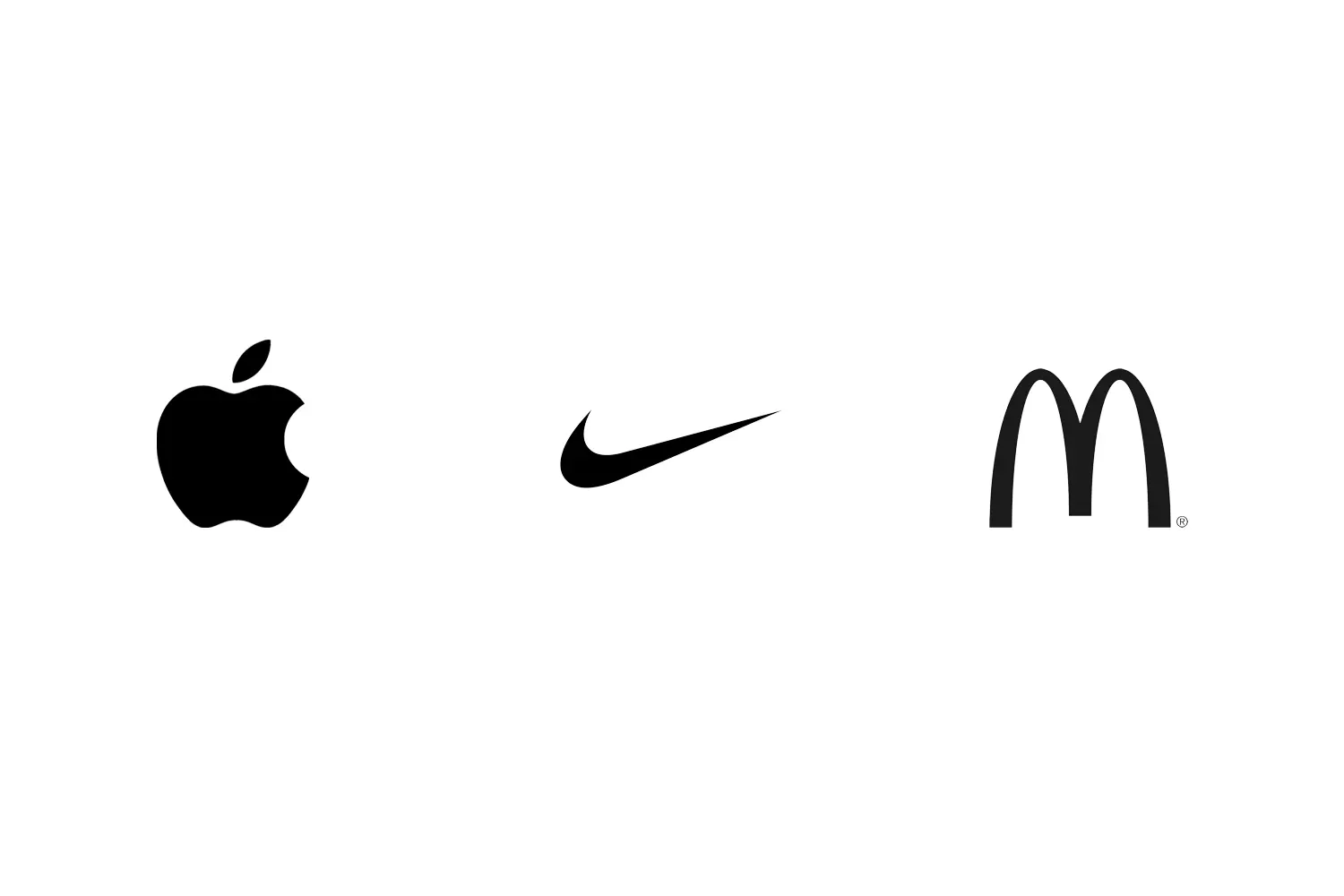
The Nike Swoosh.
The Apple logo.
The golden arches.
None of these symbols naturally mean “performance”, “innovation” or “fast food”.
They became those ideas because millions of people repeatedly experienced them.
Over time the symbols evolved into visual shorthand.
Almost like new words added to humanity’s collective vocabulary.
The symbol remained the same.
The meaning grew.
Designing Language
When psyborg® develops a new identity we aren’t asking:
“What should this logo look like?”
We’re asking something much deeper.
“What idea deserves its own symbol?”
Because once that symbol exists it begins interacting with people.
Every website.
Every business card.
Every proposal.
Every conversation.
Every social post.
Every customer interaction.
Each touch point reinforces the meaning until the mark becomes inseparable from the experience.
That’s why branding is never just graphic design.
It’s behavioural design.
Cultural design.
Language design.
Culture Begins at the Edge
Most businesses won’t change global culture.
They don’t need to.
A neighbourhood café changes local coffee culture.
A gym changes attitudes towards health.
An engineering consultancy can change how developers think about flood risk.
A local accountant can change how clients feel about financial confidence.
Every meaningful brand slightly reshapes the culture surrounding it.
Its influence might extend fifty metres.
Or fifty countries.
The principle remains the same.
Symbols influence behaviour.
Behaviour influences people.
People influence culture.
AI Makes Meaning More Valuable
Artificial intelligence can already generate thousands of logo concepts in minutes.
It can imitate style.
It can combine trends.
It can reproduce aesthetics.
What it can’t manufacture is collective meaning.
Meaning still has to be earned.
That’s why we believe symbolism is becoming more valuable, not less.
As AI floods the world with visual content, businesses won’t compete on how quickly they can produce graphics.
They’ll compete on whether those graphics actually mean something.
We’ve explored this further in our article:
Why Brand Symbolism Still Matters in the Age of AI
A New Way to Think About Branding
Perhaps the role of a brand designer has been underestimated.
We’re not simply making things look professional.
We’re creating symbols that may outlive us.
We’re adding new visual words to society’s vocabulary.
Some disappear.
Some become businesses.
Some become movements.
A rare few become part of culture itself.
That’s an extraordinary responsibility.
Design with intent.
Because every meaningful brand begins with a symbol.
Every symbol begins with an idea.
And every idea has the potential to become language.
References
- Southerton, D. (Ed.). Encyclopedia of Consumer Culture: Semiotics. SAGE Publications.
- Peirce, C. S. Peirce’s Theory of Signs. Stanford Encyclopedia of Philosophy.
- Thellefsen, L. T., Andersen, C., Sørensen, B. & Danesi, M. A Semiotic Note on Branding. Cybernetics & Human Knowing.
- Rossolatos, G. Brand Image Re-revisited: A Semiotic Note on Brand Iconicity and Brand Symbols. Social Semiotics.

Daniel Borg
Creative Director
psyborg® was founded by Daniel Borg, an Honours Graduate in Design from the University of Newcastle, NSW, Australia. Daniel also has an Associate Diploma in Industrial Engineering and has experience from within the Engineering & Advertising Industries.
Daniel has completed over 2800 design projects consisting of branding, content marketing, digital marketing, illustration, web design, and printed projects since psyborg® was first founded. psyborg® is located in Lake Macquarie, Newcastle but services business Nation wide.
I really do enjoy getting feedback so please let me know your thoughts on this or any of my articles in the comments field or on social media below.