

I’ve stumbled onto an idea that feels increasingly important.
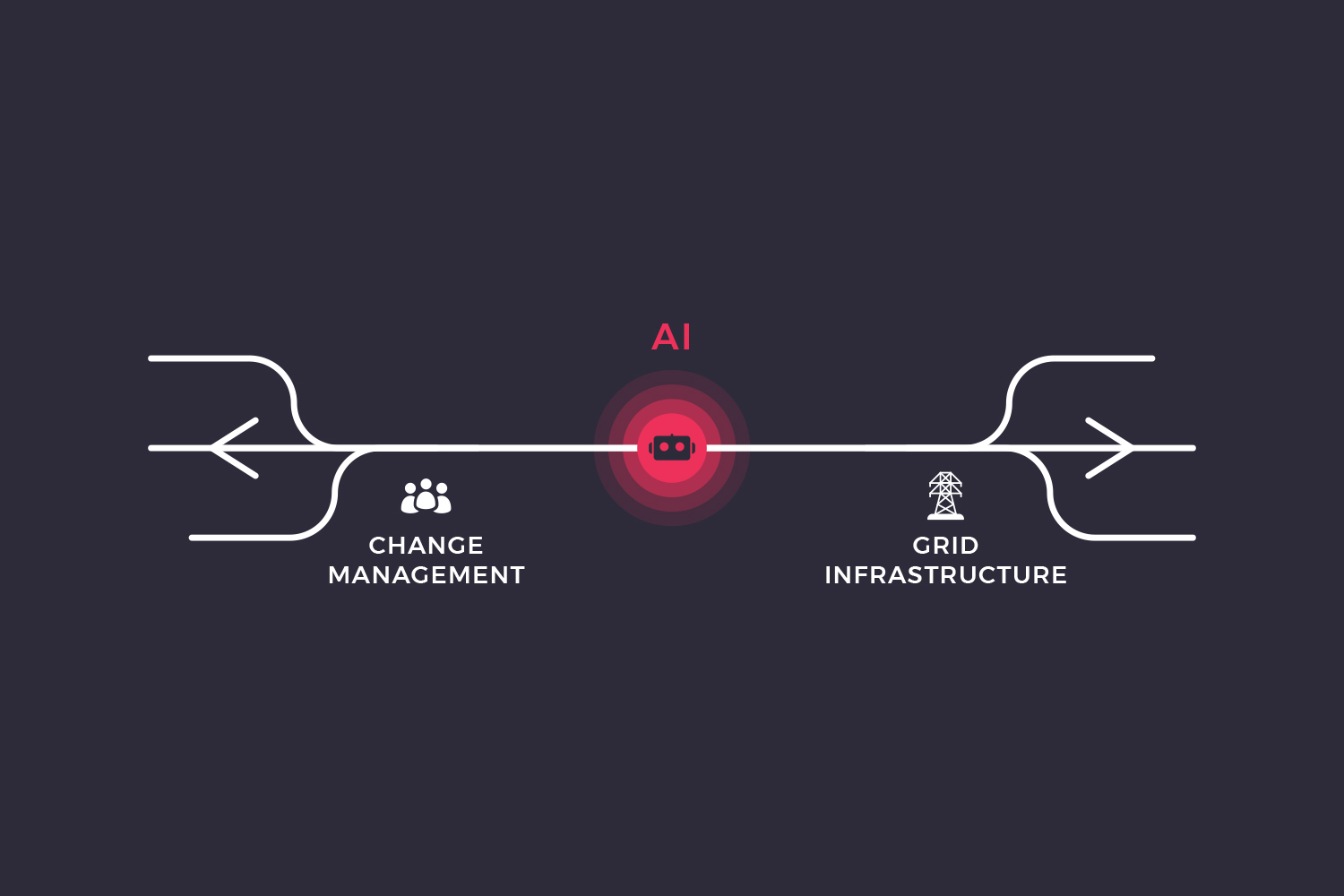
AI appears to have two opposing bottlenecks.
At one end is the human.
At the other is the machine.
Or, in psyborg® language:
part mind | part machine.
The machine intelligence sitting between them is accelerating at an extraordinary rate. Frontier AI labs are building larger models, buying GPUs, constructing data centres and pushing towards increasingly capable AI agents.
Businesses are racing to adopt the technology.
Yet the ultimate restrictions may not be the intelligence itself.
They may be the systems sitting on either side of it.
Can humans change quickly enough?
And…
Can we get enough power through the wires quickly enough?
Those two constraints could become two of the biggest opportunities created by the AI revolution.
The AI sandwich
Think of the emerging AI economy as a system.
| Layer | Constraint |
| Humans | Behaviour, skills, trust, culture and change |
| AI | Models, software, agents and intelligence |
| Compute | GPUs, servers and data centres |
| Electricity | Generation, transmission, transformers and grid connections |
Most of the attention has understandably been focused on the middle.
Better models.
More GPUs.
More compute.
More agents.
But as the middle accelerates, the slower systems around it become increasingly visible.
The faster AI gets, the more obvious the bottlenecks become.
Bottleneck one: humans have to change
Businesses aren’t struggling to hear about AI.
They’re struggling to absorb it.
McKinsey reported in June 2026 that almost 90% of organisations surveyed were experimenting with AI yet only 7% had scaled it across the enterprise. Organisations embedding AI across multiple functions were also generating significantly higher profit margins than businesses restricting it to isolated areas.
That tells us something important.
The bottleneck isn’t simply access to AI.
It’s organisational change.
PwC Australia makes the same point from another angle. Its 2026 research found that while AI has become a strategic priority for Australian businesses, only 18% of Australian CEOs believe their organisations have strong AI foundations.
PwC describes an emerging gap between an organisation’s AI ambition and how prepared its workforce is to actually deliver it. Its Australian research highlights skills, trust, human oversight and workforce readiness as central to successful adoption.
This is where AI stops being an IT problem.
It becomes a change management problem.
You can’t install transformation
Buying Microsoft Copilot doesn’t transform an organisation.
Giving everyone ChatGPT doesn’t transform an organisation.
Running an AI workshop doesn’t transform an organisation.
Those things can start the process.
Real transformation happens when people begin changing:
- how they think
- how they communicate
- how they make decisions
- how they structure workflows
- how they share knowledge
- how they define roles
- how they measure value
- how they trust machines
- how they use their own judgement
That’s significantly harder.
Technology can be deployed overnight.
Culture can’t.
A model can be updated in weeks.
A workforce can’t.
And as AI capability continues to accelerate, that difference in speed becomes more important.
The machine is getting faster.
The human system still needs time to understand what has changed.
This creates an enormous human opportunity
There will be significant opportunity in helping organisations bridge that gap.
Not simply teaching people how to prompt.
But helping businesses answer deeper questions.
How should our workflows change?
What should AI do?
What should humans continue to do?
Where does judgement remain important?
How do we communicate differently?
What happens to individual roles?
How do we manage trust?
What knowledge should AI have access to?
How do we redesign the organisation around abundant intelligence?
That is a much broader challenge than AI implementation.
It involves strategy, leadership, psychology, design, communication, systems thinking and culture.
In other words … change management.
Bottleneck two: AI ultimately needs electricity
At the opposite end of the system sits something much more physical.
Power.
Behind every apparently weightless AI conversation sits a physical chain of infrastructure.
- Servers.
- GPUs.
- Cooling systems.
- Transformers.
- Substations.
- Transmission lines.
- Generation.
- Land.
- Concrete.
- Copper.
- Steel.
- And electricity.
The International Energy Agency estimates that global data-centre electricity consumption will roughly double from 485 TWh in 2025 to around 950 TWh by 2030. Electricity demand from AI-focused data centres is expected to grow even faster, roughly tripling over the same period.
There is a fascinating mismatch here.
The IEA notes that a data centre can potentially become operational within two to three years while the broader energy infrastructure supporting it requires much longer planning and construction cycles.
The digital world is moving faster than the physical world supporting it.
AI might be software, but its limits are increasingly physical
This changes how we think about AI infrastructure.
The race isn’t only for GPUs.
It’s also for:
- Power generation.
- Grid connections.
- Transformers.
- Transmission.
- Cooling.
- Battery storage.
- Suitable land.
- Construction capacity.
- Planning approvals.
The IEA says the speed of the AI revolution is increasingly contrasting with the slower physical, social and economic systems beneath it. Grid connections and energy supply chains are already becoming significant constraints.
That’s remarkable.
One of humanity’s most advanced technologies may increasingly find itself constrained by something remarkably basic:
power and wires.
And there’s the symmetry
This is the part I find most interesting.
At one end AI is constrained by psychology.
At the other it is constrained by physics.
Humans need time to change.
Infrastructure needs time to build.
Between those two points, intelligence is accelerating.
So perhaps the ultimate AI equation looks something like this:
Humans → AI → Compute → Electricity
The centre can evolve at software speed.
The outside edges can’t.
And eventually the speed of the entire system gets determined by its slowest components.
Two magnificent opportunities
This creates two very different economic opportunities.
Opportunity one: upgrade the humans
Organisations will need help redesigning themselves around AI.
That means:
- Change management.
- AI literacy.
- Workflow redesign.
- Leadership.
- Governance.
- Training.
- Communication.
- Knowledge systems.
- Brand systems.
- Role redesign.
- Human judgement.
The companies that succeed won’t necessarily be those that simply buy the most AI.
They’ll be the organisations capable of changing themselves to use it well.
Opportunity two: upgrade the machine’s world
At the other end is an industrial opportunity measured in decades.
- Generation.
- Transmission.
- Transformers.
- Substations.
- Data centres.
- Cooling.
- Storage.
- Land.
- Engineering.
- Construction.
The technology industry may move at exponential speed.
But somebody still has to build the physical infrastructure underneath it.
The AI revolution doesn’t escape the physical world.
It makes the physical world more important.
Why this resonates so strongly with psyborg®
For psyborg®, this idea feels strangely familiar.
Our philosophy has long been:
part mind | part machine.
The phrase originally reflected the balance between human creativity and technology. psyborg® itself blends psychology, creativity, technology and systems thinking to help organisations communicate and evolve.
Today our positioning has evolved towards helping organisations find clarity while navigating change … combining strategic thinking, branding, communication, design, web and increasingly AI.
AI makes that philosophy more relevant rather than less.
Because the opportunity isn’t to remove the human.
It’s to rethink the relationship.
The machine can generate, analyse, automate and increasingly act.
The human still needs to provide context, judgement, meaning, direction and responsibility.
The organisations that learn to combine those capabilities effectively will become something new.
Not human businesses occasionally using AI.
Not automated businesses removing humans.
But organisations deliberately designed around both.
Perhaps AI isn’t really a technology transition
Maybe that’s the larger idea.
AI is usually described as a technological revolution.
I think it may be better understood as a systems transition.
The model is only one component.
For AI to transform society, entire systems around it have to transform too.
Businesses.
Workforces.
Education.
Leadership.
Energy.
Infrastructure.
Regulation.
Culture.
And that means progress won’t simply be determined by how intelligent the next model becomes.
It will also depend on two much slower questions.
Can humans change quickly enough?
And …
Can the physical world upgrade quickly enough to support the machines?
Everything else is accelerating between them.
part mind | part machine.
Perhaps that was the equation all along.

Daniel Borg
Creative Director
psyborg® was founded by Daniel Borg, an Honours Graduate in Design from the University of Newcastle, NSW, Australia. Daniel also has an Associate Diploma in Industrial Engineering and has experience from within the Engineering & Advertising Industries.
Daniel has completed over 2800 design projects consisting of branding, content marketing, digital marketing, illustration, web design, and printed projects since psyborg® was first founded. psyborg® is located in Lake Macquarie, Newcastle but services business Nation wide.
I really do enjoy getting feedback so please let me know your thoughts on this or any of my articles in the comments field or on social media below.