

If you’ve ever thought, “AI isn’t giving me what I asked for”, the problem often isn’t the AI.
It’s the brief.
Prompt engineering isn’t about learning secret commands or complicated syntax. It’s simply the skill of communicating your intent clearly. Like briefing a designer, engineer or employee, the quality of the instructions has a direct impact on the quality of the outcome.
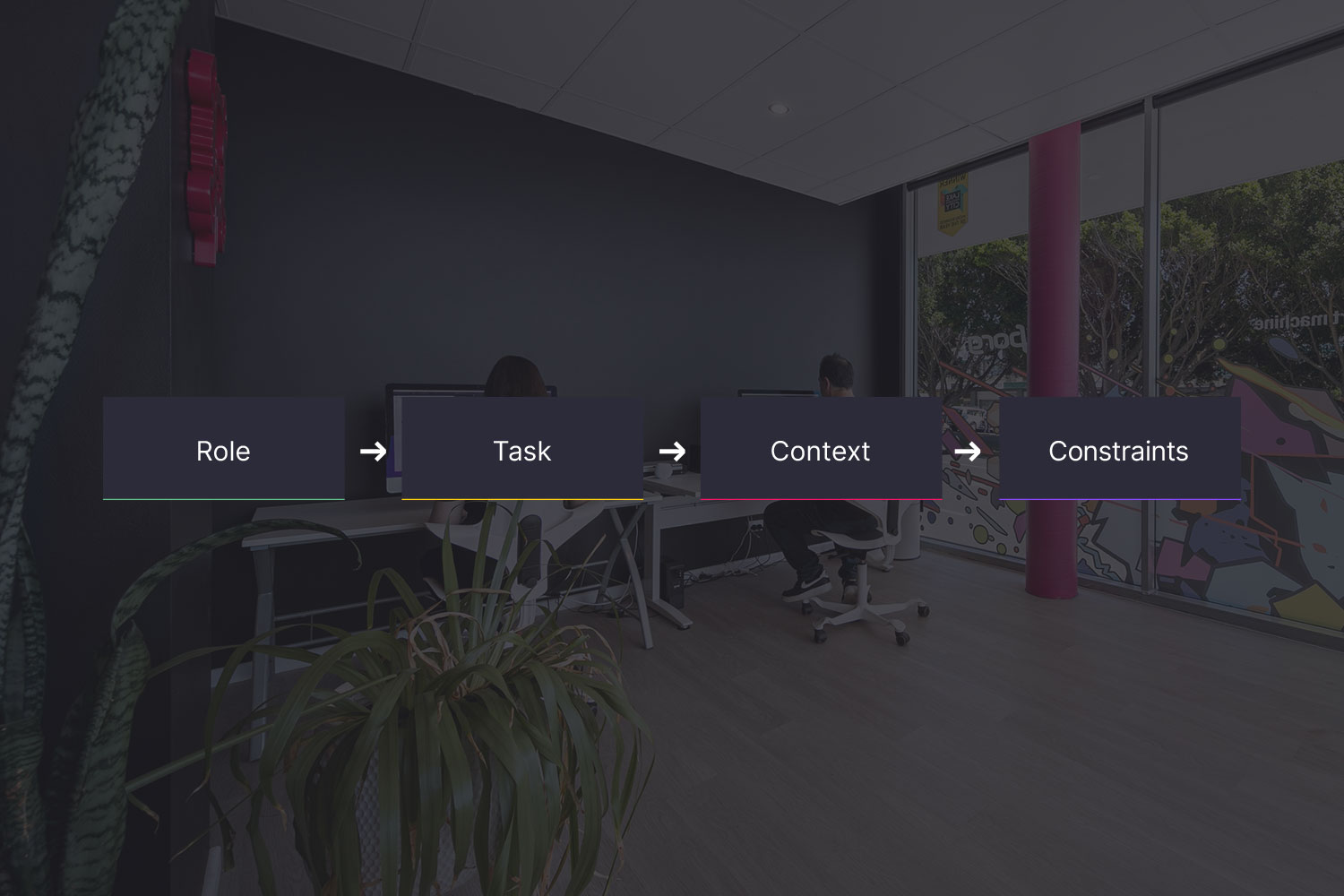
At psyborg®, we’ve found that one simple framework consistently produces better results across ChatGPT, Microsoft Copilot, Gemini, Claude and other AI platforms.
It comes down to four parts:
- Role
- Task
- Context
- Output
Master these and you’ll immediately improve the quality and consistency of your AI interactions.
Why Prompt Engineering Matters
Imagine hiring a new team member.
You wouldn’t simply say:
“Do some marketing.”
You’d explain who they are, what you want them to achieve, who it’s for and how you’d like it presented.
AI works exactly the same way.
The more ambiguity you remove, the less the AI has to guess. Better instructions create better outputs.
Prompt engineering is less about talking to a computer and more about learning to communicate with intent.
Step 1: Define the Role
The first step is telling the AI who it should be.
This establishes perspective, experience and the type of thinking you expect.
Examples include:
- You are an experienced brand strategist.
- You are a commercial lawyer.
- You are a mechanical engineer.
- You are a Year 6 teacher.
- You are an SEO copywriter.
Giving AI a role doesn’t change what it knows. It changes the lens through which it approaches the task.
Step 2: Define the Task
Next, tell the AI exactly what you want it to do.
Be specific.
Instead of:
“Help me with marketing.”
Try:
“Write a 1,000-word blog article explaining the benefits of rebranding for Australian small businesses.”
Strong task words include:
- Write
- Analyse
- Compare
- Summarise
- Brainstorm
- Critique
- Explain
- Rewrite
- Generate
- Plan
The clearer the action, the clearer the response.
Step 3: Provide Context
This is where most prompts fail.
Context explains the background.
Think about everything a human would need to know before beginning the work.
Include things like:
- Who the audience is
- Your business
- Brand voice
- Objectives
- Constraints
- Existing information
- Industry
- Location
- Budget
- Previous work
For example:
Our audience is Australian business owners with fewer than 20 employees. Our brand voice is confident, practical and conversational. We write in British English and avoid jargon.
Those few extra sentences dramatically improve the output.
Context is often the difference between an average response and one that feels genuinely useful.
Step 4: Define the Output
Finally, explain how you’d like the answer delivered.
Examples include:
- Markdown with H2 headings
- Bullet points
- A comparison table
- Executive summary
- LinkedIn post
- Proposal
- Word count
- Reading level
- Tone of voice
For example:
Present the answer as a 1,000-word blog article using H2 headings, British English, short paragraphs and finish with a call to action.
Now the AI isn’t guessing the format.
It knows exactly what success looks like.
Before and After
Basic Prompt
Write a blog about branding.
The AI has to guess:
- Who it’s for
- Length
- Tone
- Country
- Purpose
- Format
Structured Prompt
You are an experienced brand strategist at psyborg®. Write a 1,000-word blog article explaining why Australian small businesses should invest in branding before advertising. The audience is business owners with fewer than 20 staff. Use British English, include SEO-friendly H2 headings, practical examples and finish with a call to action encouraging readers to book a Brand Strategy Session.
Same AI.
Completely different outcome.
Prompt Engineering Is Becoming a Core Business Skill
A few years ago, knowing how to search Google efficiently became an advantage.
Today, knowing how to communicate effectively with AI is becoming just as valuable.
As AI continues moving into business software, phones, vehicles and physical devices, prompt engineering becomes less about using ChatGPT and more about directing intelligent systems.
It’s rapidly becoming a modern communication skill.
Take the Next Step
Reading about prompting is useful.
Practising it is where the real learning happens.
That’s exactly why we created the AI Exploration Intro Guides.
These practical digital workbooks help adults, teenagers and children build confidence using AI through guided exercises, repeatable prompt frameworks and real-world examples. Rather than simply providing prompts to copy and paste, they teach you why good prompts work and how to create your own.
Explore the workbook range:
Final Thoughts
Prompt engineering isn’t about learning a new programming language.
It’s about learning to communicate with greater clarity.
Remember the framework:
Role → Task → Context → Output
Simple.
Repeatable.
Powerful.
Because the quality of your prompts ultimately determines the quality of your thinking.
Part mind. Part machine.

Daniel Borg
Creative Director
psyborg® was founded by Daniel Borg, an Honours Graduate in Design from the University of Newcastle, NSW, Australia. Daniel also has an Associate Diploma in Industrial Engineering and has experience from within the Engineering & Advertising Industries.
Daniel has completed over 2800 design projects consisting of branding, content marketing, digital marketing, illustration, web design, and printed projects since psyborg® was first founded. psyborg® is located in Lake Macquarie, Newcastle but services business Nation wide.
I really do enjoy getting feedback so please let me know your thoughts on this or any of my articles in the comments field or on social media below.