

On 20 August 2026, I had the opportunity to speak at the first HCAA Trade Expo at Watersedge at Campbell’s Stores in The Rocks, Sydney.
It was a pretty fitting location to talk about the future.
Sydney Harbour outside. Engineers, suppliers and industry leaders inside. And a session focused on how digital transformation is beginning to reshape design and practice across the building services industry.
HCAA brought together up to 40 exhibitors for the event, with the Digital Transformation CPD session forming part of the evening program.
My presentation was titled:
The AI Paradigm Shift: Staying Human in a Machine-Shaped World
The aim wasn’t to convince a room full of engineers that AI was going to solve everything.
It was to make the technology easier to understand, more practical and a little more human.
And then ask a bigger question.
Where might all of this eventually lead?
A two-minute recap from the HCAA Trade Expo at The Rocks, Sydney.
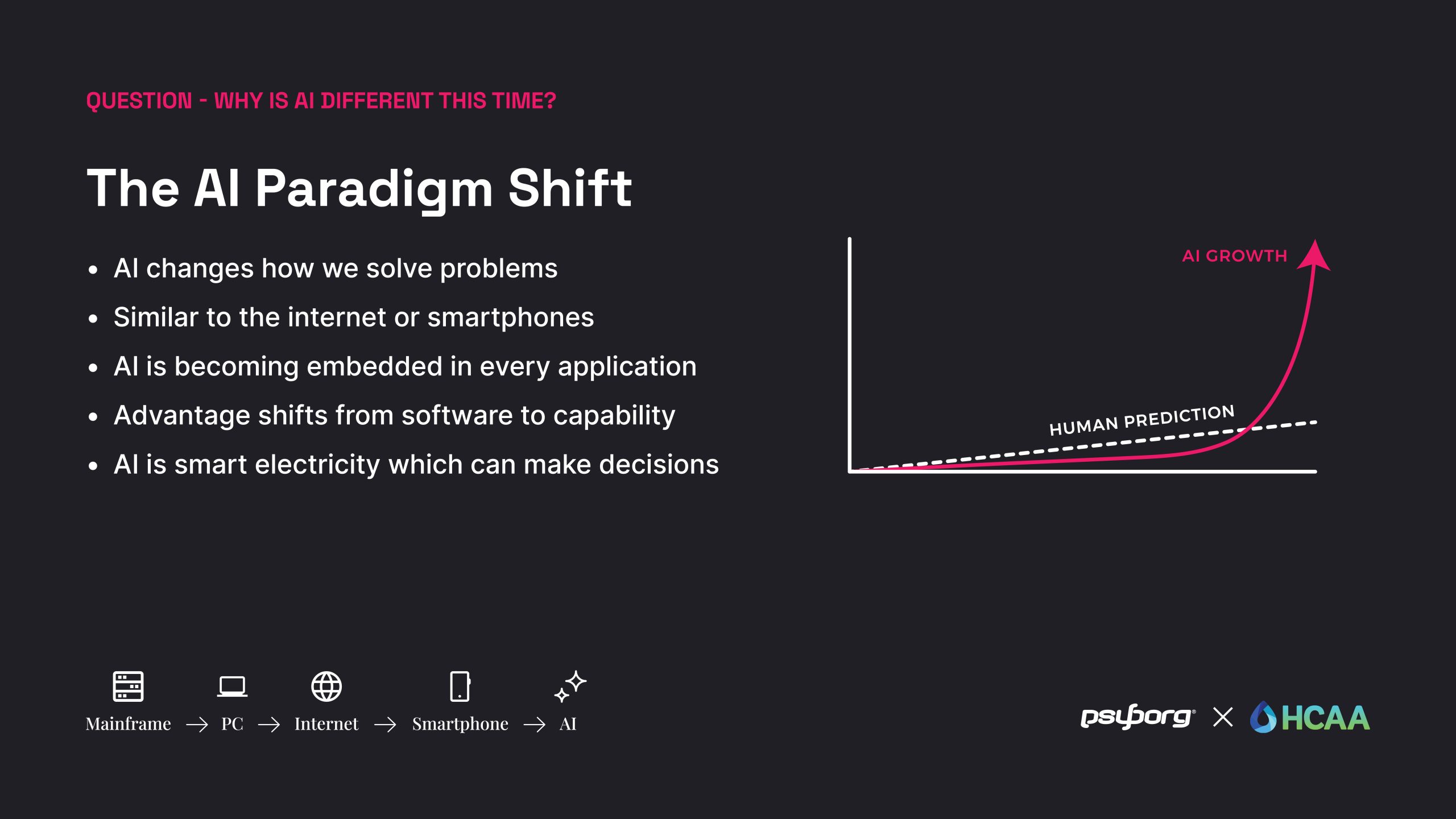
AI isn’t another software upgrade
One of the central ideas in the presentation was that AI represents something larger than another generation of software.
AI changes the way we solve problems.
It’s increasingly being embedded inside the applications we already use and the advantage is beginning to shift from simply owning software to understanding how to use intelligence effectively.
I described AI as something approaching smart electricity.
Electricity gave machines power.
AI increasingly gives software the ability to interpret, predict and act.
That distinction matters.
Because once intelligence becomes embedded into our everyday tools, the conversation changes from:
“Which AI app should we use?”
to:
“What could we do differently if intelligence was available everywhere?”
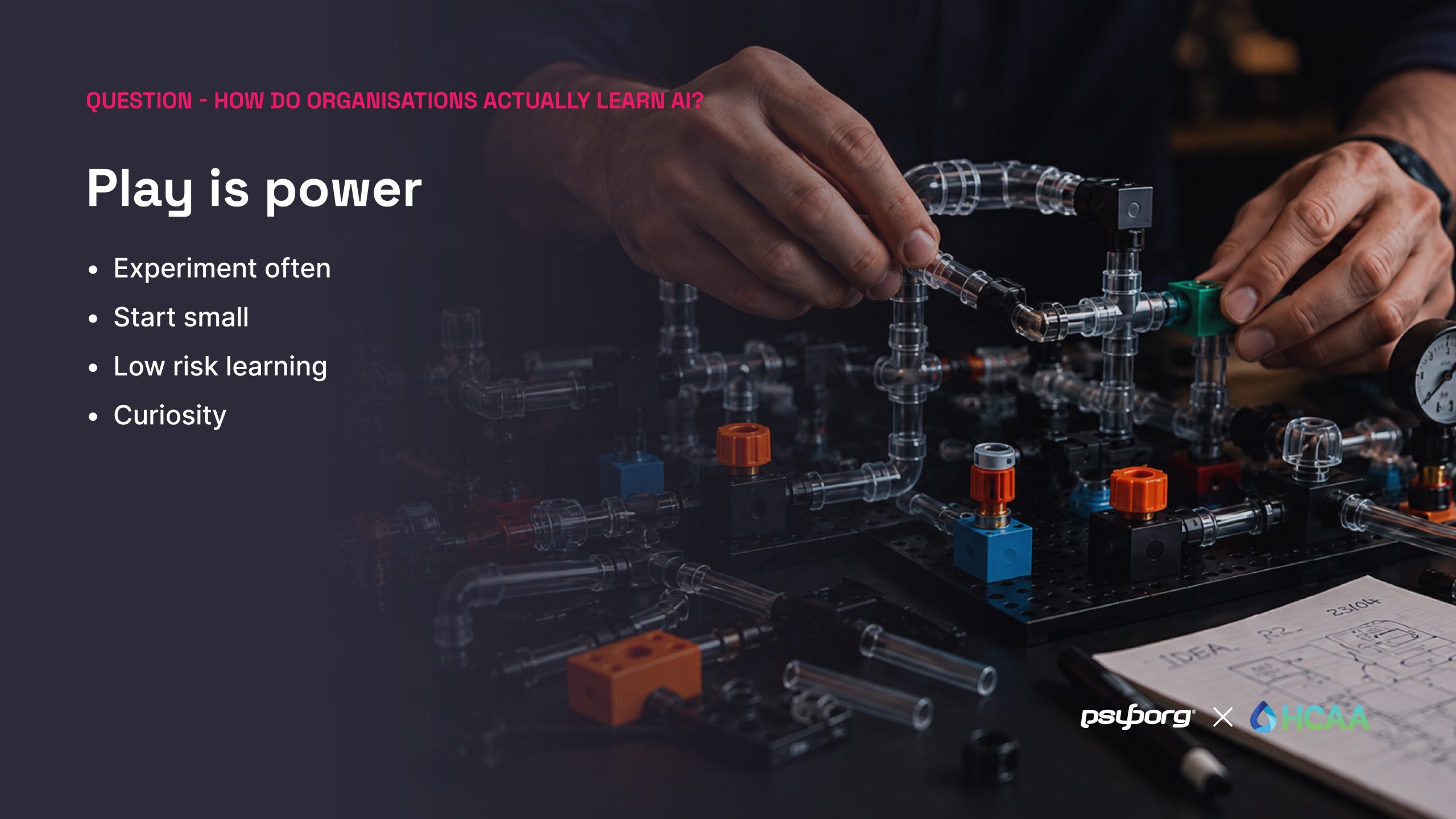
Play is power
For businesses trying to understand AI, my advice remains relatively simple.
- Experiment.
- Start small.
- Try things.
- Stay curious.
You don’t learn AI particularly well by reading policies about it.
You learn by interacting with it.
That doesn’t mean ignoring risk or governance. It means creating low-risk opportunities for people to build intuition around what these systems can and can’t do.
The businesses and industries that develop that intuition now will be better equipped to make informed decisions as the technology matures.
Keep AI on the human edge
The more capable AI becomes, the more important human judgement becomes.
That might sound contradictory, but it isn’t.
AI can process information at enormous speed and scale.
Humans bring context, accountability, creativity, experience and domain knowledge.
That’s why I keep returning to the idea of:
AI on the human edge.
Use the machine where it adds capability.
Keep humans where judgement matters.
The presentation reinforced the importance of human review and the idea of Copilot, not Autopilot.
This becomes particularly important in engineering, where decisions can have physical consequences.
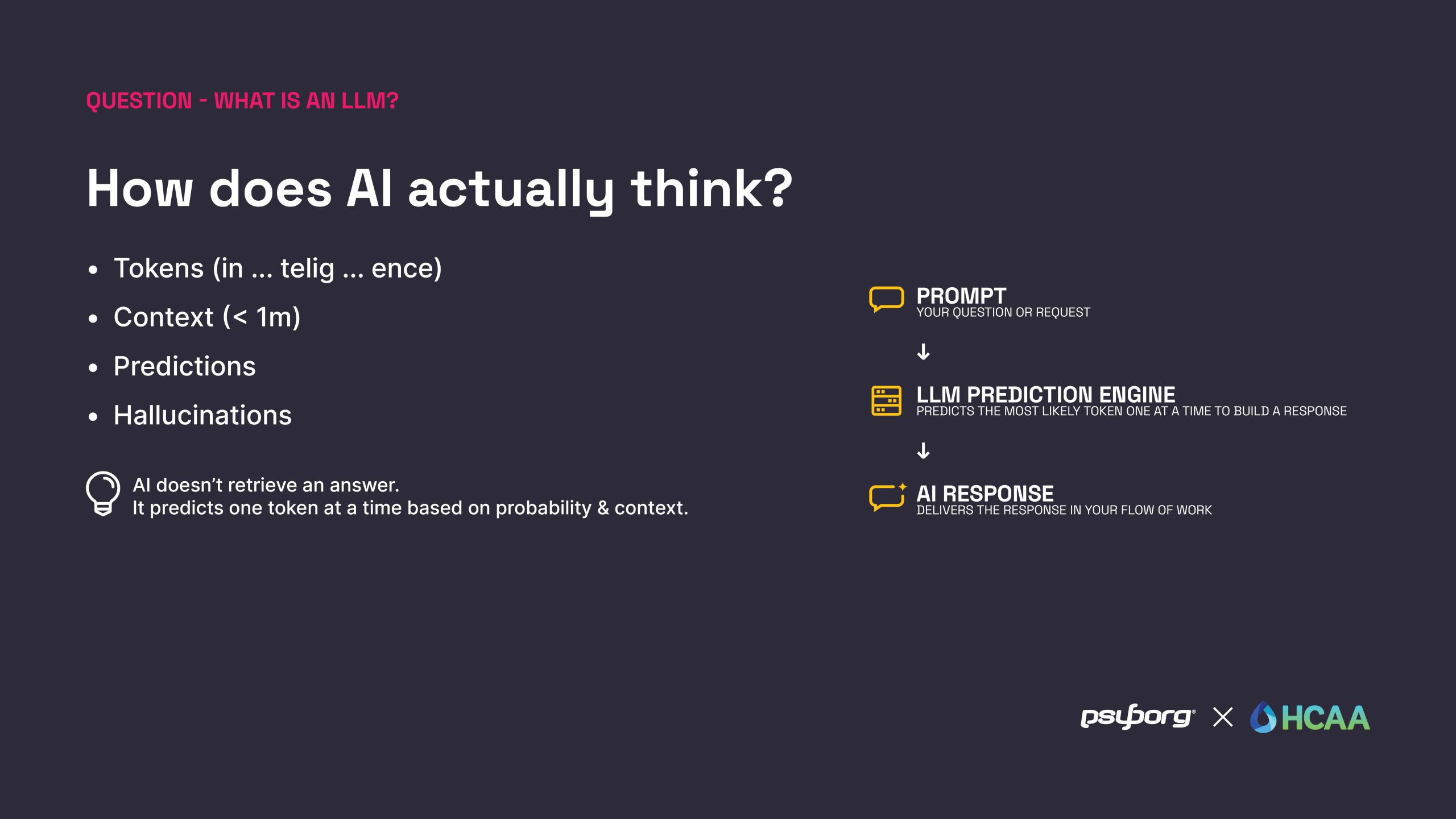
AI doesn’t really “think”
Understanding AI becomes much easier once we remove some of the mystery.
Large Language Models don’t retrieve a perfectly formed answer from somewhere inside themselves.
They generate responses by predicting likely tokens based on probability and context.
That’s incredibly powerful.
It’s also why they can be wrong.
The distinction matters because it changes how we use the technology.
We shouldn’t treat AI like an oracle.
We should treat it like an extraordinarily capable collaborator that still requires context, instruction and review.
Prompt engineering is really communication
One of the practical ideas I wanted to leave the room with was that prompting doesn’t need to feel technical.
Good prompting is simply good communication.
Give the AI:
- Role.
Who should it behave like? - Task.
What exactly do you want done? - Context.
What information should influence the response? - Constraints.
What rules or boundaries should it follow?
That structure already exists naturally in engineering briefs, creative briefs, specifications and project instructions.
AI simply makes the quality of those instructions more visible.
And increasingly, those instructions won’t just create answers.
They’ll create actions.
From chat to agents
Most people’s experience of AI today still begins with a chat window.
Ask a question.
Receive an answer.
But that’s already changing.
AI agents move beyond answering questions and begin completing tasks.
They can interpret a goal, use information, interact with tools and take multiple steps within defined boundaries.
That creates a very different future for professional software.
Instead of moving manually between systems, applications and documents, AI increasingly becomes a layer connecting them.
AI moves into the tools engineers already use
This was where the presentation started moving directly into the engineering world.
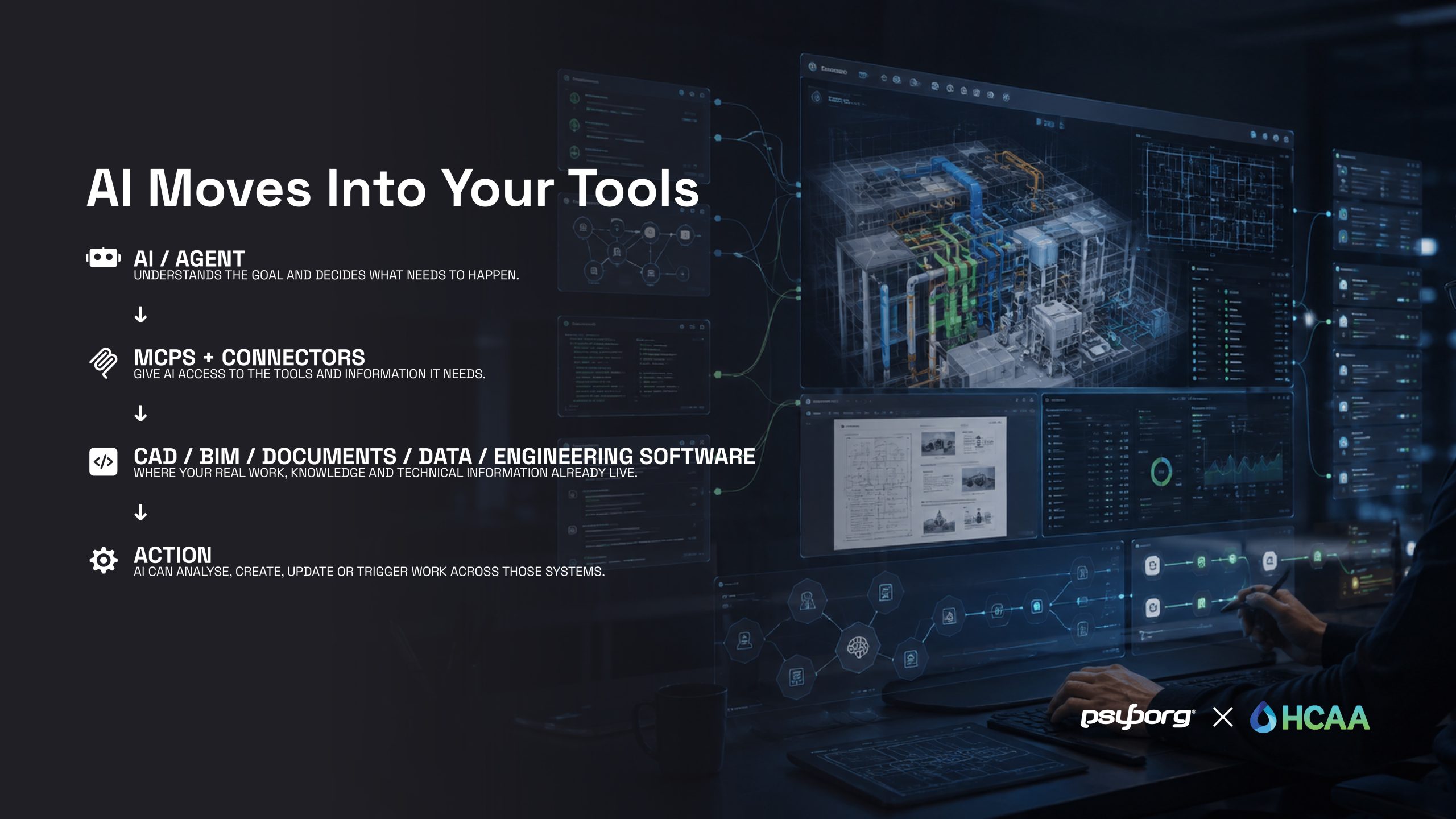
Imagine an AI agent that understands a goal.
Through connectors and emerging standards such as MCPs, it can access the tools and information needed to help complete that goal.
- CAD.
- BIM.
- Documents.
- Project data.
- Engineering software.
- Specifications.
- Reports.
The important point is that AI doesn’t remain trapped inside a chatbot.
It starts interacting with where the real work already happens.
And then things become even more interesting.
AI moves into the physical world
Buildings are already filled with data.
- Sensors.
- Meters.
- Controls.
- Plant equipment.
- Building management systems.
- Environmental monitoring.
The opportunity is not simply collecting more data.
It’s making that data easier to understand and act upon.
The presentation framed a progression from AI → Agents → Sensors → Equipment → Building Systems → Edge Intelligence.
That sparked one of the most interesting ideas from the day.
What happens when a building starts to know itself?
Not consciousness.
Not some science-fiction brain inside the mechanical room.
Something much more practical.
A connected model of how the building is actually behaving.
Imagine asking:
Why does Level 7 keep overheating every afternoon?
Which pump is behaving differently from normal?
What happens if this system fails?
Where are we beginning to see energy or water inefficiency?
The building isn’t really talking.
We’re talking to its data.
Sensors create awareness. AI creates understanding.
Sensors can tell us what’s happening.
AI can potentially help identify patterns across thousands or millions of individual signals.
That creates an interesting new interface between humans and complex physical systems.
Instead of engineers constantly searching through dashboards, reports and isolated systems, AI could begin helping translate that information into something more intuitive.
- Language.
- Visualisations.
- 3D models.
- Simulations.
- Alerts.
- Potential scenarios.
Imagine asking a building:
“What are you worried about today?”
And instead of receiving another spreadsheet, the system highlights a component inside the digital model, explains what’s changing and shows why it matters.
That’s a very different communication layer.
We don’t necessarily change the underlying physics.
We change the interface to understanding it.
What if buildings could teach engineers?
For me, this may be one of the most interesting long-term possibilities.
Traditionally, enormous amounts of knowledge are generated during the design and construction of a building.
Then the building becomes operational.
The designers move on.
Operations teams inherit it.
And a significant amount of what happens next becomes disconnected from the original design process.
But what happens if that loop closes?
A building continuously generates information about how systems actually perform.
AI helps interpret that information.
Those insights become organisational or industry knowledge.
And future engineers can use that knowledge when designing the next building.
Instead of relying only on assumptions, standards and previous experience, design decisions could increasingly be informed by real-world performance across hundreds or thousands of operating buildings.
In simple terms:
Today engineers teach buildings.
Tomorrow buildings may help teach engineers.
That changes the relationship between design, operation and learning.
If we started this industry today, would we build it differently?
That was the final question I left with the room.
If AI, connected data, sensors, edge computing and intelligent software were available from the beginning, would we structure buildings, information and engineering workflows the same way?
Would documentation still primarily be designed as static files for humans?
Would project knowledge disappear at handover?
Would every system remain isolated?
Would we design connectivity into buildings differently?
Would buildings be designed simply to operate?
Or would we design them to learn?
I don’t think anyone has all of those answers yet.
That’s precisely why this is an interesting moment.
Good business × AI = better business
Another important point from the presentation was that AI doesn’t magically fix poor systems.
It amplifies what already exists.
Poor processes.
Poor documentation.
Poor governance.
Poor information.
Poor knowledge sharing.
AI can simply make those problems move faster.
The reverse is also true.
Good business × AI = better business.
The same principle will apply to engineering.
Better information.
Better connectivity.
Better structured knowledge.
Better systems.
Then intelligence.
Staying human in a machine-shaped world
Despite all the technology discussed during the session, my main takeaway remains human.
The goal shouldn’t be to remove engineers from engineering.
Or designers from design.
Or people from business.
It should be to remove friction around them.
Let machines do more of what machines are good at.
Scale.
Speed.
Pattern recognition.
Repetition.
Let people spend more time where people still matter most.
Judgement.
Responsibility.
Relationships.
Creativity.
Experience.
That’s the opportunity I see emerging.
Not humans versus machines.
A final thought
The closing line of the presentation was:
Don’t aim to become an AI company. Aim to become a better company using AI.
For the engineering industry, I’d extend that one step further.
Don’t aim to create an AI building.
Aim to create a better building that happens to be intelligent.
That distinction will matter.
And we’re only just beginning to understand what it could make possible.
psyborg®
part mind | part machine.
Go deeper with AI
If you’re trying to understand what AI could practically mean for your business, download our free Go Deeper with AI guide.
Daniel Borg
Creative Director
psyborg® was founded by Daniel Borg, an Honours Graduate in Design from the University of Newcastle, NSW, Australia. Daniel also has an Associate Diploma in Industrial Engineering and has experience from within the Engineering & Advertising Industries.
Daniel has completed over 2800 design projects consisting of branding, content marketing, digital marketing, illustration, web design, and printed projects since psyborg® was first founded. psyborg® is located in Lake Macquarie, Newcastle but services business Nation wide.
I really do enjoy getting feedback so please let me know your thoughts on this or any of my articles in the comments field or on social media below.